Friday, July 28, 2006

Nepal rebels extend ceasefire by three months .


KATHMANDU - Nepal's Maoist rebels extended their ceasefire by three months on Friday in a bid to support peace talks aimed at ending their decade-old insurgency that has killed thousands.
The extension came hours before the truce -- declared after King Gyanendra ended his absolute rule in April -- was due to expire.
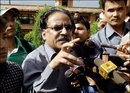
"Expressing the commitment and responsibility (for peace) our party has extended the ceasefire for another three months," Maoist chief Prachanda said in a statement.
He said an eight-point understanding between the rebels and the government last month was key to establishing lasting peace and ensuring progress in the impoverished country.
"But the government and seven political parties are trying to back out from it under different pretexts," he said.
"We strongly urge the government to show eagerness to advance the peace talks ... otherwise we will be forced to declare another strong peaceful movement," Prachanda said.
The rebels have been upset in recent weeks over what they say is a delay by the multi-party interim government of Prime Minister Girija Prasad Koirala to push the pace of peace talks and accused his coalition of trying to preserve status quo.
The rebels and the government have also differed over a government plan to seek the help of the
United Nations' to disarm the Maoist army in the run up to elections to draft a new constitution and decide Nepal's future.
The ceasefire extension came as Maoist representatives began talks with a team of U.N. officials on how the world body could assist the peace process in the troubled Himalayan country.
Officials said the meeting had started at an undisclosed location. They did not elaborate.
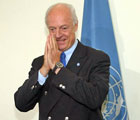
The seven-member U.N. team, headed by Staffan de Mistura, arrived in Nepal on Thursday and met Deputy Prime Minister and Foreign Minister Khadga Prasad Oli.
"This is an assessment mission that needs to understand the position of all interlocutors," de Mistura said on Thursday.
The rebels are demanding an immediate dissolution of the reinstated parliament and the formation of an interim government that would include them.
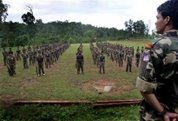
They also say that they are ready to keep their fighters and weapons under U.N. supervision but will not surrender them.
The Maoists have been fighting since 1996 to topple the monarchy -- a conflict that has killed more than 13,000 people so far.

Without any pre-established formula: Mistura


Head of the United Nations Mission to Nepal, Staffan de Mistura, has said the Mission has not come to Nepal with any pre-established formulas or
Talking to reporters at the Tribhuvan International Airport upon his arrival on Thursday, Mistura said as it shares its expertise and explains the UN's method of work the Mission would also be taking close note of the particular needs and characteristics of Nepal.
The people of Nepal have demonstrated their desire for peace, and the United Nations is committed to helping them achieve that goal. The Mission is hopeful that through dialogue with all concerned it will be possible to arrive at a common understanding about the UN role in the peace process in Nepal, he said.
Miatura said during its stay, the seven-member mission would carry out a broad agenda of meetings. In addition to its contacts with the Nepal government and the CPN (Maoist), it will also meet with leaders of political parties and members of the parliament, civil society leaders, media and the representatives of the international community.
"Through consultations with all concerned, the Mission seeks to forge a common understanding about the scope and nature of the UN role in the peace process," he added.
A press statement issued by Mistura after his arrival in Kathmandu said, “The inclusive nature of our consultations is fundamental. When the United Nations takes part in a peace process, it does so on the basis of the shared understanding of its role among the different parties to the conflict.”
The UN representative said clarity among all concerned sides is “absolutely essential if the UN is to play an effective role as an impartial third party in Nepal”.
The UN Mission comprises of personnel with expertise in the peace process in countries around the world and covers political affairs, military and police matters, electoral assistance and human rights. The Mission will work mainly in Katmandu but its members may also carry out visits to the interior of the country, according to the press release.
After completing its work in Nepal, Mistura’s team will report to the UN Secretary-General, Kofi Annan, on its findings.
“Events have been moving rapidly in Nepal and the United Nations shares the sense of urgency about maintaining momentum in the peace process while ensuring that peace is built on a solid foundation,” he said in the statement, expressing hope that consultations with the concerned sides will result in a common understanding about the role of the world body in Nepal’s peace process.

Friday, July 21, 2006

Nepal peace talks postponed.


A second round of high-level peace talks between Nepal's recently reinstated government and Maoist rebels slated for Friday has been postponed due to lack of groundwork, a rebel spokesman said. "The second round of high-level talks scheduled to be held on Friday has been deferred for the next few days as necessary preparations have remained unfinished," Maoist spokesman Krishna Bahadur Mahara told AFP.Mahara, also head of the three-member rebel talks team, did not say when the talks would take place but said he hoped they would be held "within the next week."Nepal's government and the rebels have been observing a ceasefire for nearly three months.At the first meeting between Prime Minister Girija Prasad Koirala and rebel leaders in mid-June, the two sides agreed to draft an interim constitution that would allow the rebels to join an interim government.Since then, progress on the constitution has been slow, but it is due to be completed by July 30, the drafting committee has said.This is the third time the rebels and government have tried to hammer out a peace deal. On two previous occasions in 2001 and 2003 talks broke down and the Himalayan nation was plunged back into conflict.King Gyanendra was forced to end a 14-month period of direct rule in April after Maoists in concert with sidelined political parties held nearly three weeks of protests that crippled the country.Since the rebels began their "people's war" in 1996, at least 12,500 people have been killed.

visit the geeky site..

High level UN team to visit Nepal to access help


In response to the government’s letter to the United Nations (UN), to assist Nepal’s peace process, a five-member high-level team of United Nations is arriving Nepal on July 27 to assess what needs to be done to accelerate the peace process.
The government sought the world body’s assistance in five different areas of the peace process.
The government asked the world body to assist to monitor the combatants of the Maoist and decommissioning of their arms, and to assure that the Nepal Army is inside barrack and not being used for or against any side, in order to ensure free and fair constituent assembly elections.
The letter also has asked the UN to continue monitoring of human rights through Office of High Commissioner for Human Rights (OHCHR) in Nepal, assist to monitor the code of conduct during the ceasefire.
The UN has been asked to observe the election process to the Constituent Assembly.
“We received UN response a few days back notifying that a UN team is arriving in Kathmandu on July 27,” reports quoted Dr Suresh Chalise, foreign affairs advisor to Prime Minister Koirala as saying.
He said the UN’s letter welcomed the government’s request and promised to help Nepal in all requested areas by sending its top officials.
The UN delegation will meet PM Girija Prasad Koirala, the leaders of the seven-party alliance as well as the top Maoist leaders to discuss the issue of UN help in Nepal’s peace process.
The delegation will also meet the heads, and other senior officers, of the security forces. It will also meet the representatives of the civil society and human rights activists.
However, Maoists have expressed reservation over the content of the letter.

Thursday, July 20, 2006

Maoists assure to create conducive environment .

Senior Maoist leaders have expressed commitment to allow industries to operate smoothly without any fear or threats.
Speaking at an interaction with industrialists associated with the Confederation of Nepalese Industries (CNI), in the capital on Wednesday, Maoist Chairman Prachanda and senior leader Dr Baburam Bhattarai have promised that they would encourage local investors and protect 'national capital' for effective economic development of the country.
A press statement issued by CNI said the Maoists stressed on the need to advance the future economic outlook, boost national capital, commercialise agriculture, create employment with a broader perspective and develop parallel policies for politics and economics.
On the issue of inviting foreign investment, Maoist leaders have stressed on the need for certain provisions and mechanisms so that domestic industries will not be hit hard, the statement said.
Maoist leaders have expressed inclinations towards mixed economy. However, CNI businessmen have reiterated that the government should handle sectors such as education, health, electricity and drinking water and infrastructure development, while the private sector should act as an engine of growth to boost economy.
The leaders also agreed to create a mutual understanding between managements and trade unions in the industry.
Maoists and CNI have agreed on various issues such as creation of a sound and safe industrial environment, correspondence to international media stating that Nepal possesses peaceful environment to travel, an active role for Maoists to settle tricky issues between trade unions and industrial management and developing a code of conduct for creating a long-term economic road map.
The Maoist commitment came at a time when there is confusion about the Maoists’ economic policy.
CNI has agreed in principle that it would participate at a national conference of businesspersons and create confidence between the business sector and the Maoists.

Tuesday, July 18, 2006

Nepal Blogs

Nepal Blogs: Nepalis Blog: http://uniquelynepal.blogspot.com


Real Nepalis political scenario in context to things that rule the world of a typical Nepali. Is Nepal really heading towards political outskirts to develop Nepal? Are Nepalis rulers absurd? Is the system down? Or are we Nepalis off the mind? We fought for leaders but do we really fight against our rights? Fearless blogging welcomes every concerned Nepalis to partake. You might be finding yourself to enclose in parenthesis of the Global Nepalis web logging sub-domain.


While the world is busy innovating, Nepalis find themselves waiting for some one else to do. Let we develop, let the real time bounty explode among us.


This weblog tries to explore key political transforms in the tiny Himalayan nation- Nepal. Every changes and decisions that leaders make should be directed towards public and they themselves are public. We, here at http://politicalNepal.blogspot.com, try to figure out as it happens political news and analysis to be adapted from Nepalis publications- print or web and ultimately comments from all around the world are welcomed.


URL: http://politicalNepal.blogspot.com

Email: NepalBlog@gmail.com

Language of the blog: English, occasionally Nepali

Contributors: Every speakers and commentators


Nepal Blogs Network, association of Nepalis Blogs!

All 4,000 Nepalis in Lebanon safe

All Nepalis working in various parts of Lebanon are so far safe even as heavy bombardments by Israel on Lebanese territory entered the fifth day Sunday, according to the Nepalese Embassy in Egypt, which looks after Lebanon affairs also. An estimated 4,000 Nepalis are working in Lebanon.
Bhrigu Dhungana, the Deputy Chief of Mission at the Embassy, said Sunday that no one was reported dead or injured in the clash between Israeli forces and Lebanese militant group, Hezbollah.
"We are constantly watching and assessing the situation there," Dhungana said, adding that most Nepalis, comprising a significant number of women, work as domestic helpers. "No news of attack is reported to have taken place in areas where there is the concentration of Nepalis."
Dhungana said the Nepalese mission was in constant touch with the Honorary Nepalese Consul General for Lebanon, J Issa El-Khoury, and many Nepali workers there. Though the exact number of Nepalis in Lebanon is not known as many Nepalis go to the Middle East, including Iraq, for jobs through clandestine channels, Dhungana said, there must be at least 4,000 Nepalis in Lebanon alone.
In the wake of the cold-blooded murder of 12 Nepali workers in Iraq by Iraqi insurgents in 2004, hundreds of Iraq-bound Nepalis had re-routed to Lebanon. Some 30 Iraq-bound Nepalis stranded in Jordan had entered Lebanon daily for several weeks then, according to Krishna Bhandari, a Nepali working in a Lebanese accounting firm.
Worried about the safety of their nationals currently in Lebanon, many countries have dispatched ships and aircraft to evacuate them. Israel has imposed terrestrial, aerial and naval blockade of Lebanon. Dozens of civilians, including women and children had been killed in a fire as they were about to cross to Syria on Saturday.
Dhungana said he was not aware of any contingency evacuation of Nepalis in case of emergency. "As the violence has escalated the number of locals attempting to flee has grown, but with the Israelis targeting border areas and nearby roads, this has become increasingly difficult," said a BBC report.
The clashes erupted after Lebanon's Hezbollah militants captured two Israeli soldiers last week.

Monday, July 17, 2006

‘Dual nationality to British Gurkhas will benefit Nepal

Pointing out that British Gurkhas have been a major source of remittance to Nepal, a representative of the British Gurkha community has urged the Nepal government to grant them dual nationality.

In his working paper presented at the NRN (non-resident Nepalis) Regional Conference in Bunn, United Kingdom, few weeks earlier, Hitman Gurung, a retired British Gurkha Captain, said that British Gurkhas and their dependants who are settled or preparing to settle in the UK are emotionally attached to their motherland and are willing to contribute to the growth of the nation and that a provision of dual nationality would facilitate investment and other contributions in Nepal.

“The British Government has marked history by granting British citizenship to Gurkhas, now it is time for the Government of Nepal to recognize their loyalty by granting them dual nationality which would be most beneficial to Nepal’s overall development,” he said.

In 2004, the British government decided to grant citizenships to Gurkha soldiers as a reward to their loyalty to the British sovereignty.

Gurung further said the Nepal government and the NRNs should work hand in hand in this direction.

As they have not got dual nationality, the next generation of British Gurkhas is at a risk of losing their cultural and linguistic identities as well as their responsibility to the motherland, he said.

“In a few years time, the new generation may not speak Nepali language unless we create the environment to learn Nepali. They may feel it is not necessary. The next generation may not be as lucky as we all are now to have meetings with NRN in Nepali language,” he pointed out, “A prime example is Nepalese in Fiji, where it is too late now, as they speak Hindi due to the influence of Indian community.”

Gurung’s working paper further said that increasing loss in remittance could be rectified by granting dual nationality to the Gurkhas.

There are approximately 3,500 serving Gurkhas in the British Army with nearly 4,600 dependants living in the UK who together earn an average of £13,998,000 per year while 14,000 more ex-servicemen and their dependants are based there. The serving Gurkhas, ex-servicemen and their dependants make a total of £172,375,800 per year, of which major chunk comes to Nepal.

Including the British Gurkhas, there are over 40,000 Nepalis, including students, living in UK who earn an estimated £576,000,000 a year.

The former Gurkha also suggested that NRN community form a ‘dual nationality team’ so as to establish direct links to solve the issues with the government and devise plans for contribution to Nepal i.e. in remittance, tourism, investment and welfare sector.

Sunday, July 16, 2006

17 killed, 13 missing in Kaski landslide

17 people have been killed and 13 others are missing in a landslide last night at Ulleri village-based Nepane tole of Dangsingh VDC in Kaski district.
Rescuers recovered the bodies of 17 villagers; five men, five women and seven children from debris at the site, while a search for those missing continued till late Saturday.
Those killed have been identified as Ojan Pun, Mina Pun and Gom Bahadur Pun of the same family. Others killed are Dansuba Pun, Shuv Ram Pun, Dil Maya Pun, Susan Pun, Suman Pun, Maya Pun, Rabina Pun, Jasbir Pun, Dilmati BK, Sita BK, Samkaji BK, Santa Devi BK and Bimal BK.
Keshav Pun, Kalpana Pun, Aruna Pun, Prasanna Pun, Hom Bahadur Pun, Dhan Maya Pun, Anita Pun, Sonia Pun, Jung Pun, Kamala Pun, Sabina Pun, Roman Singh Pun are missing.
13 houses were damaged while seven were totally swept by the landslide after incessant downpour. According to locals, the houses of Hom Bahadur Pun, Ojan Pun, Rupa Pun, Chimchime BK, Gaman Singh Pun, Jas Bahadur BK and Yugmaya Pun were swept away. The house of Karna Bahadur Pun was destroyed in the incident.
The village, mostly inhibited by people of Dalit and Magar community, was swept away in the landslide that started some one-and-half kilometers above the area. The village can be reached after a four-hour walk from Nayapul along the Pokhara-Baglung highway.
Locals, political party activists, security agencies and Maoist cadres were involved in the rescue operation since Saturday morning.
The people displaced by the landslide are being housed in the nearby Bhagawati Lower Secondary School. According to Man Bahadur Thapa, secretary of Dangsingh VDC, compensation will be sought for the victims’ families.

Friday, July 14, 2006

High-level commission grills then Home Minister Thapa

The high level commission formed to investigate atrocities committed during the popular movement of the country is grilling then Home Minister Kamal Thapa and Chief Secretary Lok Man Singh Karki on Friday.
The commission summoned them from 11.00 a.m. on Friday.
Talking to journalists at the premises of Commission upon arrival, Thapa said he will answer the queries of the commission. Thapa, who was there with his supporters, further said that he will answer queries of journalists after filing his statement.
According to radio reports, supporters of Thapa misbehaved with journalists and warned them not to ask unnecessary questions. They also chanted slogans in favour of Thapa.
Thapa is facing charge of using excessive force to suppress the pro-democracy movement of the country and directing security forces from Army Headquarter to use excessive force against pro-democracy activists.
Likewise, then Chief Secretary Karki told journalists that he will answer their queries after filing statement at the commission.
Karki is facing charges of playing an active role in suppressing the movement of civil servants.
Meanwhile, the Commission has summoned four former royal ministers and a police officer next week for interrogations over their role in the suppression of the janaandolan and misuse of state funds during the king's rule.
Those summoned are former ministers Khadga Bahadur GC, Roop Jyoti, Keshar Bahadur Bista and Prakash Koirala and DIG of the Armed Police Force Dilip Kumar Shrestha.
The commission had already summoned two vice-chairmen of the then council of ministers, some other members, suspended chiefs of the security agencies and people believed to be responsible for suppressing the pro-democracy movement of the country and also hinted that it might summon the then chairman of the council of Ministers.
His Majesty King Gyanendra was the chairman of the council of Ministers during the period.