Friday, August 18, 2006

Koirala for adjourning House session during second round of talks; says people will decide fate of monarchy

Prime Minister Girija Prasad Koirala has said that the house of representatives would not be dissolved but the house session would be temporarily adjourned during the upcoming second round of peace talks with the Maoist rebels.
Talking to journalists at his hometown Biratnagar on Thursday, the premier also said that each party will enter the peace process with equal commitment once a special UN team arrives within two weeks.
Koirala, who said on Wednesday that the House would not be dissolved unless the issue of arms was settled, also informed that the current session of the House would be adjourned once the UN team arrived in the country. "The House will be adjourned for the time being to focus all attention on the peace process," he said.
PM Koirala further said, “The restored House would be temporarily adjourned during the decisive round of the much-awaited summit talks.”
The PM, however, did not give any timeframe about the upcoming high-level talks to be held between the top brass leaders of the seven-party alliance and the Maoists.
He added that the current “confusion” surfacing between the seven parties and the House will disappear once the nation enters the peace process. Stating that informal talks with Maoist leadership and other homework was going on, he said "decisive-summit-talks" with the rebels would be held shortly.
Koirala, who received widespread criticism for his statement of providing some space to the King in new democracy said that it is the people who will decide the fate of monarchy and people’s verdict will be acceptable to the Nepali Congress. Koirala however reiterated that the house has also accepted the ceremonial role in its historic declaration.
“It is the people who will decide monarchy’s fate. If the people want republic they will decide. It is not only me who is talking about ceremonial monarchy but the House passed the proposal unanimously,” he added

Thursday, August 17, 2006

Arms management first: PM

Prime Minister Girija Prasad Koirala reiterated on Wednesday that parliament would not be dissolved and Maoists would not be included in the interim government until Maoists' arms are managed.
Calling parliament the "weapon" of the Seven Party Alliance (SPA) and the people, PM Koirala said that the SPA cannot "disarm" itself (dissolve parliament) until the Maoists are disarmed.
Talking to journalists at his residence, he said the management of weapons was the "root problem" and it should be addressed first. He also emphasized that Maoists would not be included in the interim government unless the rebel's arms were managed. "Once the arms are managed, the interim government will be formed and the political process can proceed."
Informing that a UN team would be arriving in the country within the next two weeks, PM Koirala said that the arms management process would begin after necessary dialogue with the UN team.
Expressing commitment to the peace process, PM Koirala said, "I will do my best to make sure that the Maoists don't head for the jungle again."
Koirala also informed that the government is constantly holding talks with Maoists and necessary homework was underway for holding summit talks with the rebels.
Koirala also spoke on the issue of party unification. He said the unification process has reached its final phase and indicated that the Nepali Congress and its breakaway faction, NC(D), would be united soon.
"While we are trying to bring an armed rebel group into the political mainstream there is no point that NC and NC(D) which share same ideology and goals should remain different parties," said PM Koirala.
PM Koirala had arrived in his hometown two days ago. He also gave directives to police chiefs and CDOs to create a sense of security among people and to re-establish police posts removed due to Maoist violence. Prime Minister Girija Prasad Koirala reiterated on Wednesday that parliament would not be dissolved and Maoists would not be included in the interim government until Maoists' arms are managed.
Calling parliament the "weapon" of the Seven Party Alliance (SPA) and the people, PM Koirala said that the SPA cannot "disarm" itself (dissolve parliament) until the Maoists are disarmed.
Talking to journalists at his residence, he said the management of weapons was the "root problem" and it should be addressed first. He also emphasized that Maoists would not be included in the interim government unless the rebel's arms were managed. "Once the arms are managed, the interim government will be formed and the political process can proceed."
Informing that a UN team would be arriving in the country within the next two weeks, PM Koirala said that the arms management process would begin after necessary dialogue with the UN team.
Expressing commitment to the peace process, PM Koirala said, "I will do my best to make sure that the Maoists don't head for the jungle again."
Koirala also informed that the government is constantly holding talks with Maoists and necessary homework was underway for holding summit talks with the rebels.
Koirala also spoke on the issue of party unification. He said the unification process has reached its final phase and indicated that the Nepali Congress and its breakaway faction, NC(D), would be united soon.
"While we are trying to bring an armed rebel group into the political mainstream there is no point that NC and NC(D) which share same ideology and goals should remain different parties," said PM Koirala.
PM Koirala had arrived in his hometown two days ago. He also gave directives to police chiefs and CDOs to create a sense of security among people and to re-establish police posts removed due to Maoist violence.

Wednesday, August 16, 2006

UML for deciding the fate of monarchy through referendum

The central committee meeting of the one of the constituents of the ruling seven party alliance, CPN-UML, has concluded that a referendum should be held to decide the fate of the monarchy.
The political report of party general secretary Madhav Kumar Nepal endorsed by the central committee said elections to the constituent assembly should be held within mid-May 2007 and provision should be made for a referendum to resolve the issue of monarchy along with the constituent assembly elections.
The report also stressed the need to forge a front of political parties, which will go for a “democratic republican order as a matter of ideology.”
“We have taken a decision under which we will try to evolve a front. The only precondition is that the parties should be inclined towards a democratic republican order,” Nepal told reporters after the marathon meeting which is yet to come to an end.
Nepal came down heavily on the government for pushing the Royal Succession Act and said, “This suggests that the government is in a mood to retain monarchy in a ceremonial form.”
He further said that the government is working at a snail’s pace and that there was a need to announce a date for elections to a constituent assembly and settle the debate surrounding monarchy through a referendum.
Likewise, the report also mentions about conducting a nationwide campaign for democratic republicanism, and the formation of an alliance of political forces that favour a democratic republic.
The meeting will now concentrate on the issues of Party’s position on issues like restructuring of the state, the proposed interim government, interim parliament and the election to constituent assembly

Tuesday, August 15, 2006

No aid for government with Maoists: US

US Senator Arlen Specter has said that US laws would not allow the US government to provide financial assistance to Nepal if the Maoists are included in the government with their weapons like Hamas in Palestine and Hezbollah in Lebanon.
Taking to journalists at the end of his two day long Nepal visit, Senator Specter said, “I believe that US is not in a position to try to determine the internal policies of Nepal. Nepal has to decide itself what Nepal wants to do. But examples of other countries make it clear that the Maoists have to give up arms.”
“Maoists have a military force. They can’t have an army of their own within an army when they are in the government. It is my hope that Nepal will work out its problems,” Specter, who is also the Chairman of the US Senate’s Judiciary Committee, said.
He added, “Maoists are on the terrorist list. They must renounce terrorism and give up arms.”
His response comes at a time when discussions are on to include Maoists into the interim government after adopting an interim constitution without arms management.
Senator Specter added, “US is not giving bad advice to PM. People don’t like to be told what they should do by some other country. It is up to people of Nepal, the PM and the seven political parties, to take the decision.”
Specter however described the joint letter of the government and the Maoists to the UN as a positive step.
Maoists have been charging the US for trying to disrupt the peace process of NEpal.

Monday, August 14, 2006

Prachanda says King shouldn’t be given space in interim statute

Maoist Chairman Prachanda said Sunday that the king shouldn’t be given any space in the interim constitution to be drafted in the near future.
“The king’s position should be suspended in the upcoming interim statute,” said Prachanda.
Speaking at a press meet here today, the Maoist supremo also said that the constituent assembly elections (to be held by mid-April next year) will decide the fate of monarchy. “Currently also, the king’s position is suspended and that his position should be suspended till the constituent assembly elections.”
Criticizing the recent remarks by Prime Minister Girija Prasad Koirala on king, Prachanda said, “There have been attempts of protecting the “autocratic” monarch in the name of ceremonial king.”
He added, “The people have already opted for republican setup and there have been attempts to bring the king back to the power in the name of ceremonial king.”
Prachanda also said though several attempts were made to force them to return to war, his party wouldn’t go back to “jungle to wage war again.”
“Rather we are ready to launch a Kathmandu-centered revolution but we won’t return to jungle.”
Hailing the eight-point deal reached between the seven-party alliance (SPA) government and the Maoists on June 16, Prachanda accused the SPA of coming under the “American influence” to urge the rebels to give up arms before joining the interim government.
“America termed the eight-point deal as the Maoist agenda, India hesitated to endorse it and the (SPA) leaders came under their influence,” he said, adding, “thereafter, there have been several attempts to compel us to return to war.”
The rebel second-in-command Dr Baburam Bhattarai was also present at the press meet.

Sunday, August 13, 2006

House should not be dissolved in haste: PM Koirala

Entrance is hitting entire nepal.
After his statement to provide space to King in new democracy received widespread criticism, Prime Minister Girija Prasad Koirala has said that there was no question of dissolving the House of Representatives until there is a reliable alternative.
While the Maoists are depending on their weapons as their source of power, parliament is the source of power and weapon for the unarmed political parties and the people, Koirala told the parliamentarians at the NC Parliamentary Party meeting held at his official residence in Baluwatar Saturday morning.
According to a party source, Koirala said that the Maoists should lay down arms before joining the interim government.
He also urged the parliamentarians affiliated to Nepali Congress to be more responsible and not to issue irresponsible statements to gain cheap popularity as the nation is moving ahead to restore lasting peace.
Koirala also said that he would never compromise with anyone at the cost of law and order, and peace and democracy in the country.
Regarding his recent controversial remarks to provide space to the King and the Maoists in democracy, Koirala asserted that his remarks were based on the reality, reports quoted a NC parliamentarian as saying.
“I will do what my conscience tells me. I am not going to bow down to anyone. The NC has been for parliamentary ways. Our MPs must not comment on superficial issues but stick to policy,” the octogenarian leader said.
On the issue of unification of the two factions of Nepali Congress, he said, “Unity between the two congresses would pave the way out of the existing national crisis. It is the need of the hour."
At the meeting, NC parliamentarians expressed serious concerns over the disregard of the Maoists toward the understandings and agreements reached with the government, as they are continuing extortions, intimidation and abductions.
In the meeting, criticizing Home Minister Krishna Sitaula for not being able to perform his role and responsibility, NC parliamentarians urged Sitaula to renounce either the ministerial position or the coordinator of the government negotiating team.

Friday, August 11, 2006

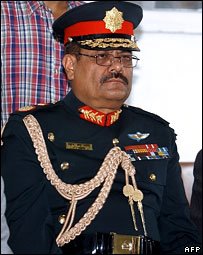
Head of Nepal's army steps down


Nepal's army chief, Gen Pyar Jung Thapa, has ended active duty.
Gen Thapa began one month's leave on Friday, a tradition for the head of the army before retiring.
Gen Thapa has been subject to widespread criticism for his role in the government's crackdown against pro-democracy activists this year.
He has denied any wrongdoing. A judicial commission interrogated him last month over the protests, in which more than 20 people were killed.
The protests resulted in King Gyanendra giving up direct rule.
The commission is yet to submit its report.
Unified command
The army's second-in-command, Lt. Gen Rukmangad Katuwal, is expected to be appointed the acting army chief.
The army led the unified command of security agencies that was deployed to maintain law and order during the protests.
Hundreds of thousands of people took to the street across the country to press for the restoration of democracy during the three weeks of protests.
A multi-party government has been in place since then.
After the restoration of parliament, the House of Representatives severed the king's ties with the army and changed the name of the Royal Nepalese Army to the Nepali Army.

Thursday, August 10, 2006

Nepal talks 'not breaking down'


A senior Nepalese minister has said there was no immediate prospect of peace talks with the Maoist rebels breaking down.
Home Minister Krishna Prasad Sitaula said the government was trying to reach an understanding with the rebels over decommissioning of their weapons.
His statement comes a day after a rebel leader, Baburam Bhattarai, warned the talks were close to collapse.
The rebels called a truce after King Gyanendra ended direct rule in April.
The Maoists and a seven-party alliance clinched a landmark power-sharing deal in June.
The government and rebels have differed recently over a government plan for the United Nations to be involved in the decommissioning of the rebels' weapons.
'No threat'
The two sides have also differed on the future of monarchy in the country.
Mr Sitaula, who is also the chief government negotiator, told the BBC that he did not see any immediate threat of the talks falling through.
He said the government was keen to reach an understanding with the rebels on the issue of handing over the weapons.
On Monday, the deputy chief of the rebels, Baburam Bhattarai said peace talks with the government could break down if it insisted on retaining monarchy.
"The talks are very close to collapse. The dialogue process is stuck at a very sensitive stage," Mr Bhattarai said.
He said his party would not return to the jungle and would launch a peaceful movement in order to make the country a democratic republic.
He said Nepalese people favoured abolishing the monarchy.
The rebel leader also accused Prime Minister Girija Prasad Koirala of trying to protect King Gyanendra, who gave up direct power in April following weeks of pro-democracy demonstrations.
The BBC's Charles Haviland in Kathmandu says that talks between the government and the rebel party are deadlocked, mainly over whether or not the Maoists should be fully disarmed before joining an interim government.
Rhetoric
Our correspondent says that some analysts believe Dr Bhattarai, known for his hardline rhetoric, may be trying to shift attention away from the weapons issue to the question of the monarchy.
Mr Koirala has been advocating a ceremonial role for the monarchy since it was stripped of its powers and privileges in May.
Entrancenepal.com is hitting the country.

Breakthrough in Nepal arms talks


The Nepalese government and Maoist rebels have reached agreement on the supervision of their weapons, an issue that has impeded their peace talks.
The United Nations will be asked to monitor both sides' arms, a joint statement issued in the capital, Kathmandu said.
Earlier this week, the rebels' deputy leader warned the talks could collapse over the future of the monarchy.
The rebels called a truce after King Gyanendra ended direct rule in April.
'Significant event'
The government has agreed that its troops will be confined to their barracks, while the rebels say their arms will be kept in one set of camps, the statement said.
It was issued after talks between Prime Minister Girija Prasad Koirala and Maoist leader Prachanda.
"It is a significant event in the peace process. We have been able to respond to the aspirations of people for peace and prosperity," the government's main negotiator, Home Minister Krishna Prasad Sitaula said.
For the rebels, negotiator Krishna Mahara was equally positive: "The agreement has decreased the mistrust and opened door to move ahead with the peace process."
Analysts say the deal could pave the way for the Maoists to join an interim government before a constituent assembly decides the country's future.
The Maoists and a seven-party alliance clinched a landmark power-sharing deal in June.
It followed a sustained campaign of street protests in April that culminated in King Gyanendra surrendering his powers.
But in recent weeks talks have stalled over the issues of arms and whether Nepal should continue to have a monarchy.
The Maoists favour a communist republic, while Prime Minister Koirala has been advocating a ceremonial role for the monarchy. The Nepalese government and Maoist rebels have reached agreement on the supervision of their weapons, an issue that has impeded their peace talks.
The United Nations will be asked to monitor both sides' arms, a joint statement issued in the capital, Kathmandu said.
Earlier this week, the rebels' deputy leader warned the talks could collapse over the future of the monarchy.
The rebels called a truce after King Gyanendra ended direct rule in April.
'Significant event'
The government has agreed that its troops will be confined to their barracks, while the rebels say their arms will be kept in one set of camps, the statement said.
It was issued after talks between Prime Minister Girija Prasad Koirala and Maoist leader Prachanda.
"It is a significant event in the peace process. We have been able to respond to the aspirations of people for peace and prosperity," the government's main negotiator, Home Minister Krishna Prasad Sitaula said.
For the rebels, negotiator Krishna Mahara was equally positive: "The agreement has decreased the mistrust and opened door to move ahead with the peace process."
Analysts say the deal could pave the way for the Maoists to join an interim government before a constituent assembly decides the country's future.
The Maoists and a seven-party alliance clinched a landmark power-sharing deal in June.
It followed a sustained campaign of street protests in April that culminated in King Gyanendra surrendering his powers.
But in recent weeks talks have stalled over the issues of arms and whether Nepal should continue to have a monarchy.
The Maoists favour a communist republic, while Prime Minister Koirala has been advocating a ceremonial role for the monarchy.

Tuesday, August 08, 2006

PM’s statement valid till CA polls: Home Minister Sitaula

At a time the Prime Minister is facing criticism for his statement to provide some space for the King in the democracy, Home Minister Krishna Prasad Sitaula defended his statement saying it is valid till the election of the constituent assembly.
Speaking at a programme in the capital on Monday, Sitaula said “What Girijababu (Koirala) has said should be construed as holding good until the election to constituent assembly is held.”
“We all know that the NC has left it to the constituent assembly to decide the fate of monarchy. Hence, what Girijababu said should not be construed to mean that we are for something else,” Sitaula said.
Commenting on the statement of Maoist leader Dr. Baburam Bhattrai that the peace process may be stalled from such comments, Sitaula said that they are in regular contact with the Maoists and there were not major differences between them.
“It is misleading to say peace process has failed. In fact, we are very close to coming to an understanding over resumption of the efforts,” Sitaula added.
Earlier, Deputy PM Amik Sherchan came out openly against a section of people in the government for working on cross purposes on the issue of writing letter to the UN.
He also threatened to resign if there is no improvement.
The central committee meeting of the CPN-UML also concluded that the statement of Koirala is against the sprit of the Jana Andolan (People’s movement) II.
Talking to FNCCI delegates at his official residence Sunday evening, Prime Minister Koirala said that King should be given a space in democracy to prevent him from being frustrated, which he said could lead to desperation.